Thursday, 7 September 2017

Meditation: Choosing Living Presence (22:40 min) - Tara Brach


Meditation: Choosing Living Presence –

A meditation on being present with our living, breathing life (includes chanting the Om’s – a favorite from Tara’s Wednesday night archives).

photo: Janet

The post Meditation: Choosing Living Presence (22:40 min) appeared first on Tara Brach.


from RSSMix.com Mix ID 8196908 https://www.tarabrach.com/meditation-choosing-presence/

Friday, 1 September 2017

True Resilience – Part 2: Awakening through All Circumstances - Tara Brach

True Resilience – Awakening through All Circumstances – Part 2

Spiritual resilience enables us to deepen compassion and wisdom as we navigate life’s difficulties. In this two part series, we will look at the conditions that incline us towards or away from True Resilience, and explore practical and powerful practices that nourish this precious capacity.

The post True Resilience – Part 2: Awakening through All Circumstances appeared first on Tara Brach.


from RSSMix.com Mix ID 8196908 https://www.tarabrach.com/true-resilience-part-2/

The Mindful FAQ: Can Mindfulness Do More Harm than Help?

My mother read somewhere that mindfulness could be damaging because it can trigger uncontrollable emotional trauma. She’s worried that I may be doing a practice that could harm my mental health. What can I tell her to reassure her?

Your mother obviously loves you very much and doesn’t want you to suffer, but I think she may be a little overprotective in this case. There is some very interesting research out of Brown University done by Willoughby Britton and colleagues, which has sought to understand the range of experiences of meditators, including looking more closely at difficult, challenging, and sometimes disruptive experiences that meditators have had. This is a complex topic, but suffice it to say that the vast majority of these unfortunate experiences have occurred in people meditating over long periods, in multiday silent meditation retreats, and we still know very little about what led to these incidents. Adverse events like this are exceedingly rare in the more common mindfulness-based programs widely available.

There is nothing to be gained from forcing yourself to meditate or “pushing through” difficult feelings. Think of it as a “melting” process rather than a “mining” one.

That said, I don’t mean to totally dismiss the potential pitfalls of mindfulness practice. Sometimes, when people have difficult or extensive histories of trauma or abuse, meditation practice may put them in touch with those memories and emotions, and they can sometimes feel overwhelming, particularly at first. For this reason, if you have a history like this it’s wise to be working with a therapist while exploring the practice of mindfulness. The key here is moderation, patience, and a willingness to be kind to yourself. If you feel that a particularly challenging feeling or memory is growing too big or intense to bear, the most mindful thing you can do is to choose intentionally to disengage, focus on your breath, let go of the formal practice, and focus on sensations in the body or something outside yourself, like the view outside the window or across the room. These actions can give you an opportunity to emotionally and physically settle. There is nothing to be gained from forcing yourself to meditate or “pushing through” difficult feelings. Think of it as a “melting” process rather than a “mining” one.

This article appeared in the October 2017 issue of Mindful magazine.

Confessions of an Anxious Meditator

Is Mindfulness the Future of Therapy?

The post The Mindful FAQ: Can Mindfulness Do More Harm than Help? appeared first on Mindful.


from RSSMix.com Mix ID 8196908 https://www.mindful.org/mindful-faq-can-mindfulness-harm-help/

Belonging Is Believing

I found one! Someone who actually answers political polls over the phone—an endangered species in the call-screening age. Sure, it’s not on a par with stumbling across a unicorn or a four-leaf clover, but it still made my day. It offered an opportunity to ask a question that has been gnawing at me: What’s happening psychologically when people believe claims that are factually untrue and definitively debunked, such as that Barack Obama is a Muslim who was born in Kenya?

In my October 2015 installment of “Brain Science,” I described what cognitive psychology has shown about why misinformation is “sticky.” I delved into why many people still believe something like the erroneous claim that weapons of mass destruction were found in Iraq after the 2003 invasion even after hearing that claim disproved repeatedly. Once we think something is a fact, it’s hard to replace it with a new fact.

The reasons I cited then were numerous. We’re wired to assume, initially, that an assertion is true, because questioning it is cognitively more demanding than accepting it. We’re also inclined toward “motivated reasoning,” a form of cognitive bias whereby we’re more likely to accept claims that conform to our existing beliefs. In the case of Iraq’s supposed WMDs, that belief might be that no evil is too great for Saddam Hussein or that the US invasion (sold to the public through the WMD claim) was justified. To someone who holds either or both beliefs, acknowledging the absence of WMDs produces a feeling of cognitive uneasiness and even threat, because the foundation of the belief (Saddam: evil; invasion: justified) is now shaky. As I wrote in the earlier column, “Misinformation is sticky because evicting it from our belief system requires cognitive effort,” and if it “fits with our worldview, then…the debunking clashes with that view” and makes us uncomfortable.

The affiliations we have (such as our favorite sports team or our dietary choices) create filters that govern how we perceive other people’s actions and assertions. It makes it hard to see eye to eye.

All of these factors are still in play. But so is a growing phenomenon: call it cognitive tribalism.

We have many ways to identify ourselves as part of a community that gives us a sense of belonging and purpose. Nationality. Religion. Gender. Even sports-team allegiance. We all want, and even need, to feel part of something larger than ourselves. The many reasons for our need to belong are worthy of a future column, but one of the key drivers is our desire to lessen the sting of mortality: I will die, but the communities of which I am a part and to which I have contributed will live on.

“We are relational beings,” said Drew Pate, a psychiatrist at Maryland-based Sheppard Pratt Health System. “Finding ways to be connected is something we seek out.” In a time of hyperpartisanship in the United States, people are using “ideology or politics as a means to connection and a way to self-identify” just as much as they use ethnicity, nationality, or other traditional affiliations, according to Pate.

Such affiliations have enormous power to shape our thinking and belief. Consider a sports bar debate over who is the greatest quarterback ever: Peyton Manning or Tom Brady? New Englanders who consider their Patriots allegiance a core part of their identity will go to their graves insisting it’s Brady—even though in the five playoff games where the two faced off Manning won three times. “You may not totally believe something,” said Pate, “but you feel you have to agree with it to affirm your sense of identity.”

Some of us are more prone to this than others. In a 2017 study in the journal Applied Cognitive Psychology, Jan-Willem van Prooijen of Vrije University Amsterdam queried some 5,000 people about whether they believed conspiracy theories, such as “there has been a free energy source for a long time, but the oil industry tries to keep this a secret,” or that astronauts “never really landed on the moon; everything was recorded in TV studios.” Those who had received more education were less likely to believe these claims than people who had received less education.

But the discrepancy he uncovered is not about intelligence. One of the strongest predictors of belief was feeling powerless, and that is associated with education: People who drop out of school are less likely to get jobs and live lives that make them feel empowered. When you feel that forces beyond your control are buffeting you, you can be driven to believe in even conclusively debunked conspiracies, van Prooijen concluded.

But feeling powerless does something else, too: it strengthens one’s affiliation to a group. Such chosen affiliations are independently correlated with believing debunked claims. In a 2010 study in the Journal of Experimental Psychology, for instance, researchers led by David Weise, then at the University of Arizona, found that the more people focused on their group identity—or “social category”—the more likely they were to accept the validity of an untruth that painted those outside the group in a bad light.

Which brings us to my unicorn poll responder. For years she gleefully told pollsters that yes, she believes Obama is Muslim and that he wasn’t born in the United States. On the first, according to a 2010 Newsweek poll, she was in the company of about one-quarter of US adults. On the second, 72% of Republicans doubted or flat-out disagreed with the statement that Obama was born in the US, according to a 2016 NBC News poll.

But when I asked if she really and truly believed either, she hedged. She “wanted to show them” (the pollsters) that there were many who opposed Obama’s policies (she disliked the Affordable Care Act), and answering as she did to questions about his faith and birth seemed like a good way to do that. It was also, she said, a way for her to feel part of the bloc that opposed him, cementing an identity that had become important to her…like Patriots fans will profess their eternal belief in Brady’s greatness even if they harbor doubts. Belonging to and aligning with a community is a stronger drive than absolute truth about one’s beliefs.

Such cognitive tribalism is manifesting itself ever more strongly. Political divisions in the US and elsewhere are growing sharper, becoming what psychologists call salient, or top-of-mind, in a way that they weren’t a few generations ago. Salient categories of self-identification (Patriots fan) are exactly the kind that skew our perceptions and judgments.

Affiliations create filters that govern how people’s actions and assertions are perceived and make it hard for people to see eye to eye. Many liberals hold up Bill Clinton as a hero, while conservatives see him as a disgraced president who narrowly avoided being convicted by the Senate after his 1998 impeachment. And liberals are of course not immune to believing myths shared by members of the cognitive tribe they identify with. According to a 2007 poll, 40% who described themselves as liberals said the US government perpetrated the 9/11 attack or allowed it to happen.

Likewise, cognitive tribalism is at work when supporters and non-supporters of Donald Trump see two very different people. If it seems incredible to some that supporters accept his assertion that 5 million people voted illegally or that his inauguration crowd dwarfed all others, it shouldn’t. “They see him as their voice,” Frank Luntz, a Republican consultant and pollster, told reporters last May. “And when their voice is shouted down, disrespected, or simply ignored, that is an attack on them, not just an attack on Trump.” When one is attacked, one doubles down on a belief if that belief forms an important basis for self-identification.

“Affect and cognition evolved together, and we don’t make any political decisions strictly cognitively,” said Emory University psychologist Drew Westen, who applies psychological science to politics. The more a politician’s supporters feel that that support defines them, and then perceive that he is being attacked, the more likely they are to succumb to the cognitive tribalism that leads people to agree with false, debunked statements…as long as doing so strengthens their sense of belonging and identity.

Brainware: Us vs. Them

The cognitive bias that looks at our own group more favorably than others’ has been discussed for over a century. Sociologist William Sumner, in 1906, wrote about the opposition in our minds between the “we-group” and the “othersgroups.” In the “struggle for existence,” he postulated, a person tends to show favoritism toward their own group, and ultimately, “looks with contempt on outsiders.” His “ethnocentrism” has since broadened to “in-group bias,” the tendency to exaggerate the positive qualities of those we identify with and ascribe negative traits to outsiders.

This article appeared in the October 2017 issue of Mindful magazine.

The Stickiness of Misinformation

Beware Your Biased Brain

The post Belonging Is Believing appeared first on Mindful.


from RSSMix.com Mix ID 8196908 https://www.mindful.org/belonging-is-believing/

Thoughts Are Not Facts—But They Speak to the Power of Judging

Like much of the best science fiction, the British TV series Black Mirror explores what might happen if some of the technologies we use today became more powerful and widespread. In an episode called “Nosedive,” we’re treated to a world where the social media convention of liking/not liking and rating everything is taken to extremes. You’re rated on every interaction with everyone you encounter from your boss to your barista—and they rate you back. To top it off, all ratings contribute to your cumulative score, and everyone is fitted with eyeglass-like implants that allow them to see your score. Those with lower scores get worse jobs, worse places to live, and have few or no friends above their rating level. The main character has a few bad days and her score plummets, eventually resulting in her being completely ostracized. It’s fiction, but it rings a little too true—a chilling statement on the power of judging.

We have a natural tendency to think that the thoughts we generate in our minds are our own.

Where do the snap judgments and other thoughts come from that can cause us to inflict so much pain on ourselves and each other? We have a natural tendency to think that the thoughts we generate in our minds are our own. We cook them up in our own heads. We decide whom we like and don’t like and what is good and bad. It’s what makes me me. 

But in fact thoughts enter our heads from all kinds of places and they hang around waiting to be recycled at the appropriate moment. As the song about racism from South Pacific says,

You’ve got to be taught

To hate and fear…

University of San Francisco law professor Rhonda Magee emphasizes media literacy—knowing how the views we hear expressed from a young age from figures of authority and in the media enter our minds and become our own, usually unexamined. Even a simple thing like the weather report repeatedly telling us that rain is “bad weather” trains us to think less of the needs of farmers and more of the needs of vacationers.

Magee also teaches mindfulness, because there are two ways that it can support our efforts to not be overtaken by views and judgments that insidiously creep into our minds: It can help us to see that a thought is not necessarily a fact, before we act on it; and it can help us be aware of what’s happening when we take in new information. Does it seep in unfiltered, or do we make room to evaluate it?

If we were just thought-beings, our judgments might not be such a problem, but we’re connected to bodies that can take action—including sharing thoughts out loud. Thoughts deserve our attention. They are where the best and worst of who we are is born.

This article appeared in the October 2017 issue of Mindful magazine.

Fear Less, Love More

Thoughts Are Not Facts

The post Thoughts Are Not Facts—But They Speak to the Power of Judging appeared first on Mindful.


from RSSMix.com Mix ID 8196908 https://www.mindful.org/thoughts-not-facts-speak-power-judging/

The Mindful Survey: Foot In Your Mouth?

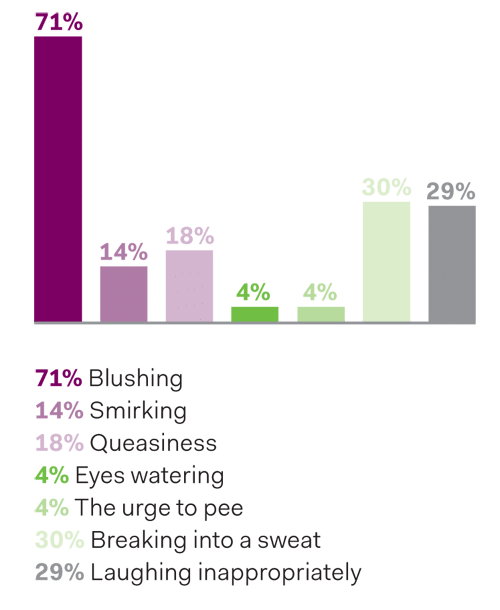
How does embarrassment manifest in your body?

Graph: how does embarrassment manifest in your body?

What’s something other people find embarrassing that you don’t?

  • “Garlic breath.”
  • “Talking about bodily functions.”
  • “Food in my teeth—it happens sometimes!”
  • “Doing what I feel like all the time.”
  • “Perfect matching outfit.”
  • “Public release of gas.”
  • “Talking about sex.”
  • “Clumsiness.”
  • “My grandson hates when I hug him in public.”
  • “Asking questions. Not knowing something.”
  • “Having a messy house.”
  • “Taking clothes off for sex.”
  • “Sending food back.”
  • “Getting a compliment.”
  • “Tripping in front of others.”
  • “Using the wrong word.”
  • “Pooping in public washrooms.”
  • “Forgetting someone’s name.”

What are you most often embarrassed by?

42% of respondents said they are most often embarrassed by being put on the spot—so why do so many of us do it to others so much of the time? Next up, at 33%, is saying the wrong thing. Physical fumbles or clumsiness gets 10% of people, while 7% of people are most embarrassed by showing emotion, 5% are embarrassed by someone else around them being ridiculous, and for 3% are embarrassed by public displays of affection.

Is it more embarrassing to show up too early or too late?


Who in your life has the greatest power to embarrass you?

27% are most easily embarrassed by complete strangers, followed by coworkers at 24%, romantic partners at 22%, and siblings at 11%. Parents have the greatest power to embarrass 9% of respondents, while 4% report their best friends, and 3% say their drunk uncles have the most power to trigger embarrassment.

Are you easily embarrassed?

  • Yes 48%
  • No 52%

What’s one embarrassing thing about yourself?

  • “My facial expressions reveal how I feel.”
  • “I’m not the most graceful girl you’ll ever meet.”
  • “The embarrassing thing is the fact that my face turns red when I am embarrassed or nervous. It really bothers me.”
  • “Not good at small talk.”illustration of cats
  • “Thinking I am informed about a situation at work when I am not.”
  • “I love mayonnaise.”
  • “I fart unexpectedly while doing exercise.”
  • “Not knowing something, or having attention focused on me.”
  • “I tend to say exactly what I think when I’m tired.”
  • “I go cross-eyed when I hear or say something weird!”
  • “I have 5 cats and that’s 4 too many.”


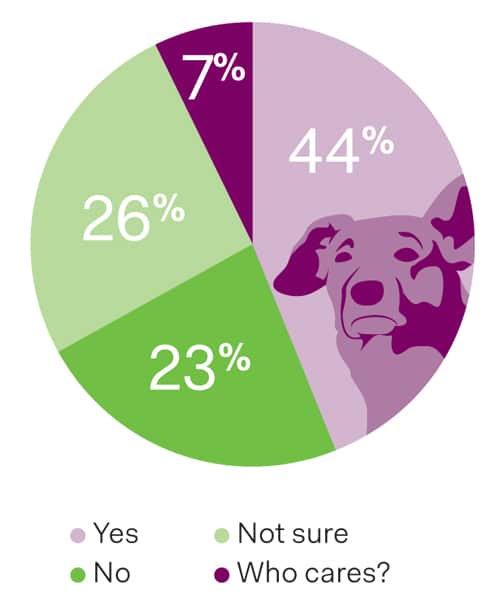
Do you think dogs get embarrassed?


Graph: Do you think dogs get embarrassed?

How do you get over embarrassment?

32% of people don’t—instead they ruminate over the embarrassment for days. Another 29% of people laugh it off. 22% suffer through it, while 9% deflect attention to someone else, and another 8% slink away.

What’s the most embarrassing thing you’ve ever done?

  • “Sorry, nope.”
  • “Wrong first marriage.”
  • “Insulting a child in a football game.”
  • “Got caught sneaking a look at the new men’s bathroom at church.”
  • “Got caught having sex in public.”
  • “Dressed as a clown to a fancy dress party.”
  • “Spilled red wine on a cream carpet of my boyfriend’s boss at Xmas.”
  • “Thanked someone for a gift in person when it wasn’t for me.”
  • “Peed on a friend’s porch. They knew I had to pee and intentionally made me laugh and wouldn’t open the door. I think they felt bad after!”
  • “Hitting ‘Reply All’ instead of just replying to one person.”
  • “Marrying my second husband.”
  • “Split my pants in front of everyone.”

What’s one thing you’ve always wanted to do but are too embarrassed?

  • “Cry in public.”
  • “Dance naked in the moonlight.”
  • “Be matter-of-fact about my talents and skills.”
  • “Submit something for publication.”
  • “Have an open relationship.”
  • “Tell people to fuck off.”
  • “Cut my hair short.”
  • “Go to a nudist colony.”
This article appeared in the October 2017 issue of Mindful magazine.

Is Shyness Holding You Back?

A Basic Meditation to Tame Your Inner Critic

The post The Mindful Survey: Foot In Your Mouth? appeared first on Mindful.


from RSSMix.com Mix ID 8196908 https://www.mindful.org/mindful-survey-foot-mouth/

Singer-Songwriter Jewel: How to Turn Fear into Happiness

South Las Vegas Boulevard in mid-May is blindingly bright and has far more traffic than I’d expect on a weekday afternoon. As I maneuver my red Yaris among the taxis, Ubers, and much fancier rentals than my own, I’m mystified why there are so many people out on the Strip midday on a Thursday.

It’s so hot, for one thing. And it hurts my eyes. The relentless sunshine bounces off everything—buildings, windshields, concrete. But worse than the glare is the sheer amount of stimulus: the faux Eiffel Tower and fountains and a gazillion stores and huge billboards of famous faces and flashing signs and club music pouring out onto the sidewalks and hawkers handing out coupons and women teetering by in heels not made for walking with guys carrying cocktails-to-go and groups of tourists posing for photos. I’m having a hard time keeping my eyes on the road and realize too late that I’m in the wrong lane. I floor it to move over, and zoom through the light before it changes, throwing a feeble, “I’m sorry! I don’t know where I’m going!” wave to anyone I may have pissed off. I can feel my nerves crackle and my palms begin to sweat.

Ironically it’s mindfulness that brings me here. I’ve come to meet Jewel, the singer-songwriter whose 2016 memoir Never Broken: Songs Are Only Half the Story shared with the world the many mindful practices she developed as a teenager to help deal with the anxiety, fear, and insecurity she struggled with since childhood. These practices remain an essential part of her life today. Now she wants to teach others that they, too, can change their experience of life, no matter where they start from, and find their own happiness.

Although it’s been more than 20 years and 11 albums since her debut record, Pieces of You, to many Jewel is still best known as the soulful singer-songwriter with an impressive range (she yodels, no less) from Alaska, discovered at age 19 playing in a San Diego coffeehouse while living out of her car. But as the book title hints, there’s much more to this story.

And this unlikely clickbait town is the surprising base for an ambitious slate of programs and projects with Jewel’s mindful philosophy at their core. I’m eager to learn more.

This is an excerpt of Mindful’s feature on singer-songwriter Jewel from the October 2017 issue of Mindful magazine. Subscribe to the digital issue of Mindful to get immediate access to the October issue.

Singer-Songwriter Jewel Shares Her Mindfulness Practices

5 Rituals of Highly Creative People

The post Singer-Songwriter Jewel: How to Turn Fear into Happiness appeared first on Mindful.


from RSSMix.com Mix ID 8196908 https://www.mindful.org/singer-songwriter-jewel-turn-fear-into-happiness/