Thursday, 12 October 2017

Meditation: Present Heart (14:38 min) - Tara Brach

Meditation: Present Heart –

We awaken a present heart by relaxing with the breath, and bringing the kindness of a smile into our bodily experience. This meditation ends with offering blessings to our inner life and all beings.

photo: Shell Fischer mindfulvalley.com

The post Meditation: Present Heart (14:38 min) appeared first on Tara Brach.


from RSSMix.com Mix ID 8196908 https://www.tarabrach.com/meditation-present-heart/

Tuesday, 10 October 2017

How Your Brain Stops a Bad Day from Making You Hate Everyone

Everyday life is filled with events that evoke emotional highs and lows—like celebrating a friend’s birthday, getting cut off in traffic, or even stubbing a toe. Amid all these ups and downs, how do we remain clear-headed in our judgments?

Remarkably, feelings about one situation rarely color our first impressions of new people or situations that we encounter soon afterward. We seem to have a built-in regulatory mechanism to protect us from this “emotional spillover,” and a recent study published in the journal Psychological Science explored a specific brain area that might be responsible.

Would disrupting the region of the brain known to be involved in controlling impulsive urges lead people’s emotions to cloud their judgments more than usual?

This region is known to be involved in controlling our impulsive urges, like when we choose healthier food over junk food. Disruption of the lPFC, either by TMS or by brain damage, leads people to have less self-control and to be more influenced by their environment. Now the question was: Would disrupting the lPFC lead people’s emotions to cloud their judgments more than usual? Researchers Regina Lapate, Richard Davidson, and colleagues at the University of Wisconsin-Madison recruited 27 people to have a part of their brain temporarily shut off. Specifically, the researchers used a technique called transcranial magnetic stimulation (TMS) to disable or “knock out” a brain region called the left lateral prefrontal cortex (lPFC).

The researchers tested this by showing participants a series of neutral faces, each of which was preceded by a briefly flashed photo of a happy or a fearful face. These brief flashes have been shown to affect our feelings, so they served as a proxy for everyday life situations that evoke emotions. After seeing the neutral face, participants rated the likeability of this person on a 1-to-4 scale. Each participant rated 144 neutral faces: half while their lPFC was knocked out, and half while a control brain region was knocked out (to serve as a comparison).

As expected, emotional spillover occurred only when the lPFC was inhibited. In that case, participants found neutral faces that followed fearful faces significantly less likeable than those that followed happy faces.

The impact that this emotional spillover had on the participants’ first impressions of the neutral faces was profound—and, as it turns out, persistent.

Three days later, long after the TMS had worn off, participants were shown all the neutral faces they had seen in the experiment. For each face, they were asked, “How much do you like this person?” on a scale from ‘really dislike’ to ‘really like.’ Neutral faces that had originally followed fearful faces when the participants had their lPFC inhibited were once again rated as less likeable than other faces.

These results are the first to causally suggest that the lPFC, in conjunction with its connecting brain regions, plays an important role in emotion regulation. Its activity seems to allow our impressions of new people and experiences to be relatively unvarnished by the constant barrage of emotional stimuli we encounter every day.

However, emotional spillover isn’t an all-or-none phenomenon. Indeed, research suggests that people with anxiety or depression may have impaired lPFC function. The extent of emotional spillover also likely varies from person to person and by context. As the researchers write, “In everyday life, the magnitude of [emotional]  spillover probably depends not only on an individual’s regulatory capacity and lPFC intactness but also on the intensity of the emotional event, the awareness of its influence, and the interval between emotional processing and subsequent events.”

The good news is that learning about how our brains regulate our emotional responses can suggest ways to strengthen this ability—and possible avenues for future research. Contemplative practices such as mindfulness meditation are particularly attractive possibilities, as there is already evidence that they can change how some parts of the brain respond to emotional stimuli.

In the end, this study may get us one step closer to limiting emotional spillover even further than the brain already does naturally, making sure we don’t miss out on a new best friend because of a still-throbbing stubbed toe.

This article was adapted from Greater Good, the online magazine of UC Berkeley’s Greater Good Science Center, one of Mindful’s partners. View the original article.

Can Meditation Lead to Lasting Change?

Feeling Moody? Here’s Why.

The post How Your Brain Stops a Bad Day from Making You Hate Everyone appeared first on Mindful.


from RSSMix.com Mix ID 8196908 https://www.mindful.org/brain-stops-bad-day-making-hate-everyone/

Friday, 6 October 2017

River of Change – Part 1: Bringing a Wise Heart to this Impermanent Life - Tara Brach

River of Change – Bringing a Wise Heart to this Impermanent Life – Parts 1 & 2 –

These two talks look at how we relate to change – especially the notable changes involving loss of relationships and our own body and mind. We examine our strategies for avoiding uncertainty and fear; the consequences of resisting reality; our refuges of presence and compassion in the face of grief; and the gifts of opening fully to the river of change.

Your support enables us to continue to offer these talks freely. If you value them, I hope you will consider offering a donation at this time at www.tarabrach.com/donation/.

With gratitude and love, Tara

photo: pixabay.com

The post River of Change – Part 1: Bringing a Wise Heart to this Impermanent Life appeared first on Tara Brach.


from RSSMix.com Mix ID 8196908 https://www.tarabrach.com/river-change-part-1/

Kindness Practice for Families with Christopher Willard

Empathy is declining in our children. Recently, researchers surveyed 10,000 middle- and high-school students—eighty per cent reported personal achievement was more important to them than caring for other people.

It’s neurologically impossible to be both stressed out and really loving and kind at the same time.

What’s at the heart of this crisis in compassion? Too much screen time, for one. Stress is another factor. The hormone oxytocin, responsible for connecting and bonding us to our kids, giving us that warm, fuzzy feeling during caregiving—that hormone works on the same receptors in the brain as cortisol, the stress hormone. And therein lies the tension: It’s neurologically impossible to be both stressed out and really loving and kind at the same time.

Kind Wishes Practice for Families

This is an informal mindfulness practice that you can do with your family. It’s the basis of most compassion and empathy training. You can do this practice on birthdays, or when other opportunities to make wishes come around. You can also use this practice to wind down before bed.

1) To begin, find a comfortable sitting position. You can even place a hand on the heart. Allow your eyes to close or lower your gaze toward the floor.

2) Bring to mind someone who you really respect and look up to, and who really loves you in return. Notice how you feel as you bring this person to mind.

3) Make a kind wish and send it their way. What would make them happy?

4) Next, bring to mind someone else you love and care about: A family member, a friend, a beloved colleague. Just bring this person to mind, sending this person a kind wish.

5) We’ll move from here to a more neutral person. Perhaps someone you don’t know very well: A parent you see occasionally in the pick-up line, a person who delivers your mail, or makes your coffee in the morning. Just bring this person to mind and imagine yourself sending them some kind of kind wish.

6) Lastly, bring to mind someone who has frustrated you lately, someone who is a little difficult. Send this last person a kind wish—something nice for them in their life.

Check in with your mind and body as you conclude this practice. Allow your eyes to open if they’ve been closed. Notice if there’s any shift.

The point of is: We don’t have to be perfectly loving beings at all times. We don’t have the psychological, financial, or genetic resources to literally treat everyone as we treat our own child—let alone treat our own child as we’d always like to. Instead, we strive to do our best and aim for that middle path: loving, caring, and acts of kindness. Because compassion, and even self-compassion, runs in families. I encourage you to find ways to practice compassion. What you do now will make a difference for future generations.

Christopher Willard’s latest book, Raising Resilience: The Wisdom and Science of Happy Families and Thriving Children, was released at the beginning of October.

The Future of Education: Mindful Classrooms

Body Scan for Kids

The post Kindness Practice for Families with Christopher Willard appeared first on Mindful.


from RSSMix.com Mix ID 8196908 https://www.mindful.org/kindness-practice-families-christopher-willard/

Thursday, 5 October 2017

Meditation: Saying “Yes” to Life (16:30 min) - Tara Brach


Meditation: Saying “Yes” to Life –

This meditation guides us in relaxing through the body, then opening to the changing river of experience. By continually relaxing back and letting go into what is unfolding, we discover the natural vastness, wakefulness and vitality of our essential Being.

The poet Danna Faulds writes: In the shared quiet, an invitation arises like a white dove lifting from a limb and taking flight. Come and live in truth. Take your place in the flow of grace. Draw aside the veil you thought would always separate your heart from love. All you ever longed for is before you in this moment, if you dare draw in a breath and whisper “yes.”

photo: Jon McRay

The post Meditation: Saying “Yes” to Life (16:30 min) appeared first on Tara Brach.


from RSSMix.com Mix ID 8196908 https://www.tarabrach.com/meditation-saying-yes-life/

Using Mindfulness for Mental Health

“Evidence-based” is a term Patricia Rockman hears often. As the co-founder of the not-for-profit Centre for Mindfulness Studies in Toronto, Rockman and her colleagues are committed to bringing the most effective mindfulness-based interventions to the most disadvantaged and marginalized in our society—the poor, homeless, unemployed, and disabled—as well as the “front-line workers” who interact most directly with them.

According to the center, mental-health problems, including depression and anxiety, disproportionately impact these groups, which also face the greatest economic and social barriers to getting proper treatment.

The research is strong for mindfulness’ positive impact in certain areas of mental health, including stress reduction, emotion and attention regulation, reduced rumination and for reducing mild to moderate depression and anxiety, preventing depressive relapse. There’s also some early evidence that it can be advantageous for people struggling with addictions, and appears to be particularly promising for smoking cessation. And when suffering causes someone to “have a fixed and negative view of themselves … or their circumstances,” Rockman says, mindfulness can help give them access to a different perspective, helps them open to other possibilities, and enhances resilience and their capacity to tolerate distress.

But mindfulness isn’t a one-size-fits-all solution, she warns. “I think it’s really important to know mindfulness is not a panacea,” Rockman says.  “We do need to step back and be discerning about what it’s good for—or at least not harmful—and where we need to be cautious.”

Who Should Use Mindfulness for Mental Health?

Clients in the center’s personal and community programs are screened before they start any of the mindfulness-based interventions. “If someone is too sick—too depressed, too dysregulated, has unprocessed trauma or is actively psychotic—and doesn’t have adequate supports, we let them know that this likely isn’t a good time for them to enter one of our programs. They really need to receive some other form of treatment first,” she says. “We need to know when to refer and when mindfulness is a suitable option for treatment or self-care.”

“Is mindfulness better than medication or other therapies? No, probably not”

Also key to the organization’s mission is to support the people who deal directly with those who have the greatest needs. The Community Program, which Rockman calls “the heart of the center,” teaches mindfulness to professionals, including social-service workers, guidance counselors, and people who work with the homeless.

“We tackle the needs of the caregivers using mindfulness for stress management and to prevent burnout, as well as the needs of clients they serve who may have serious and persistent mental illness,” Rockman explains.

Is Mindfulness More Effective than Medicine?

In all of their programs, Rockman notes, “evidence-based” is an important quantifier. For example, MBCT has been well researched and found to be as effective as antidepressants in preventing depressive relapse.

But even with this sanction, mindfulness programs may not be enough to meet the needs of certain clients, and for others its role may be best viewed as part of an overall treatment plan, as “one of the interventions that help,” Rockman says.

“Is mindfulness better than medication or other therapies? No, probably not,” she says. “But if you are someone who doesn’t believe in taking medication or seeing an individual therapist you might be more inclined to engage in the practice of mindfulness.

“So, it becomes, ‘OK, we have a modality that people like, it’s appealing and accessible to them, so they’re more motivated to use it.’ [In that case] mindfulness may work better for them.”

Ultimately, she adds, it may be that providing people with a number of options for treating mental-health conditions, managing chronic illness, or reducing stress is actually the best medicine. ▫


On Sunday Oct. 15 a four-hour event will raise money to support to the Centre for Mindfulness Studies’ Community Program. The Mindfulness Challenge, featuring meditation instruction, yoga, and more, will be offered in three locations (Toronto, Oakville, and London) and also virtually. Participants are asked to raise donations for their enrollment. Learn more here.


Is Mindfulness the Future of Therapy?

Is Mindfulness Safe?


The post Using Mindfulness for Mental Health appeared first on Mindful.


from RSSMix.com Mix ID 8196908 https://www.mindful.org/mindfulness-mental-health/

Wednesday, 4 October 2017

3 Ways to Feel More Empowered at Work

People tend to operate from a mindset of either empowerment or disempowerment at work. Choosing the former can make a big difference in how you feel about your job.

Feeling empowered at work is energizing. You approach your job with enthusiasm, as if you have everything to offer, and everything to gain. You sense that your contributions are valued and are eager to share ideas. An empowered organization is the result of a clear mission, good management, and realistic expectations about resources and workload.

If you feel disempowered at work, you’re likely stressed out, feel like there’s never enough time and maybe that your contributions don’t matter. The workday can feel like a house of cards—if one card falls, it will all crumble. Organizationally, people are defensive and anxious, and both resources and support appear scarce.

The workday can feel like a house of cards—if one card falls, it will all crumble.

Like being an optimist or pessimist, some people just naturally approach life from a more empowered or disempowered stance. And the reality is, our professional worlds are dynamic and we all move through periods when we feel both ways. But choosing empowerment begins with facing your internal dialogue.

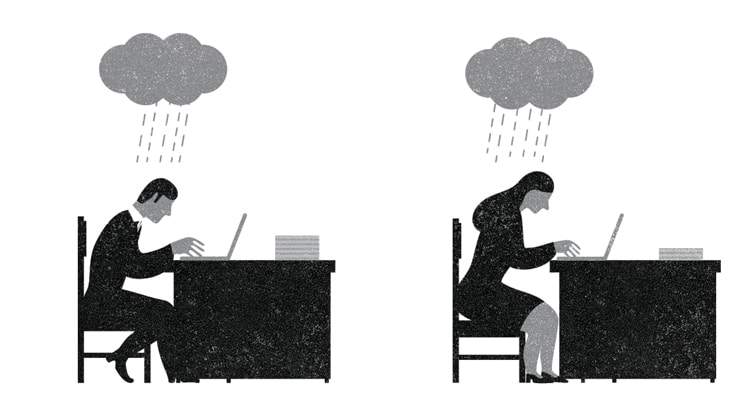
man and woman working at desk with raincloud overhead

Take your work pulse

Begin to tune in to your thoughts about work. What messages do you tell yourself (and by extension, others)?

I’m really excited about this new project.

It doesn’t really matter what I do, because my boss is going to take credit anyway.

I’m going to try for that promotion. I think I’ve got a good chance.

I’d like to get ahead, but I just can’t take on anything else.

Another reorg? This company is a disaster. I’ve just got to keep my head down, do my work, and update my resume.

What about the dominant mindset of your organization? Disempowered coworkers and teams struggle with boundaries and meeting their deliverables. They may be less willing to collaborate because they feel defensive and protective.

The opposite is true for an empowered workplace: There are clear boundaries around individual responsibilities and support for people to get their work done. People enjoy their jobs, and there’s a sense of openness and collaboration.

How do you shape the story?

Consider how you contribute to the mindset you or your team has toward work.

If there’s a rumor circulating, do you pass it on, or do you look for data that supports it?

Do you notice your thoughts before you give them voice?

When you hang out with colleagues, do you complain about what’s wrong, or do you brainstorm solutions to address what could be improved?

How often do you acknowledge the work of others and show gratitude for support you’ve received?

Shift disempowered thoughts

When you notice your thoughts veering in the direction of disempowerment, ask yourself, Is it true?

Is it true that there’s not enough time (support, encouragement, opportunity, etc.)?

Is it really true that my contribution doesn’t matter or isn’t noticed?

If you notice a bit of space opening up, go deeper.

Is this still the conversation I want to have with myself and others about work?

And if it’s not, what might you do to take disempowering thoughts in a new direction?

This article appeared in the August 2017 issue of Mindful magazine.

Quiz: Do You Feel Empowered at Work?

5 Common Workplace Obstacles that Impact Well-Being

The post 3 Ways to Feel More Empowered at Work appeared first on Mindful.


from RSSMix.com Mix ID 8196908 https://www.mindful.org/3-ways-feel-empowered-work/