Monday, 7 August 2017

How to Find the Right Meditation Posture for Your Body

Meditation isn’t only about the mind—it’s also about the body. And believe it or not, meditation isn’t meant to be physically uncomfortable. Getting your posture right is key to staying relaxed and alert instead of tense or spaced out. Without that, it’s nearly impossible to focus on the present moment.

Chances are that when you start, meditation will feel a little awkward or uncomfortable. That’s okay. Finding the ideal meditation posture and seating arrangement can take a while. There’s no one-size-fits-all approach—it takes time to familiarize yourself with the subtleties of your unique body. We offer the basic guidelines to help you get started or make some tweaks.

Posture Pointers

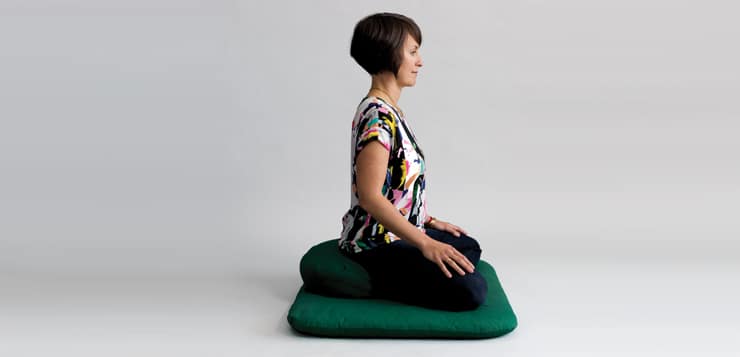
  • EYES gaze slightly downward, 4 to 6 feet in front of you. Or eyes closed.
  • CHIN slightly tucked to keep your cervical spine aligned.
  • SPINE follows natural curvature—upright, yet natural.
  • SITTING BONES are centered and stable—not perched too far forward or spread too far back.
  • ARMS parallel to the torso, palms fall naturally on the thighs.
  • KNEES below hips, with legs loosely crossed.

Cover Your Bases

If you’re planning a longer session (30+ minutes), it pays to come prepared. Here’s our list of essentials: a glass of water, shawl or blanket, warm socks, timer or clock.

5 Tips for Basic Seated Meditation Posture

1) Seat

Keep your butt centered

If your seat isn’t comfortable, the rest of your body will likely tense up, which makes meditating pretty difficult all around. Keep your butt in the center of the cushion or chair—if you’re too far forward your spine will arch to compensate; if you’re too far back it’ll curve forward.

When you first sit down, rock back and forth on your sitting bones to loosen up and find solid ground. From there, the rest of your posture will more easily fall into place.

Spine

Stay straight and relaxed
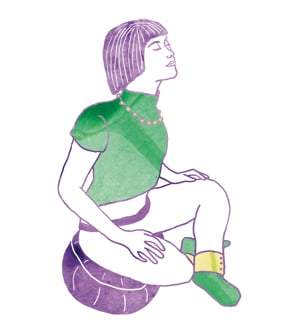
illustration of woman arching her spine in seated meditation pose

There are two main ways the spine gets out of whack during meditation: arching or slouching. When you have more than a natural arch, things stiffen and strain, and the mind is more likely to get frantic. On the flipside, it’s hard to feel present and alert when you’re slouched, your hands are sliding off your knees, and your chin is down. To align your spine, drape your body forward, then slowly straighten up, feeling each vertebra stack as you go.

Legs

Find the right height

man in seated meditation pose, knees too high

If your knees are above your thighs, your hips, back, and neck will strain. For the long-legged among us, this could mean finding a higher cushion.

Sitting in a Chair

illustration woman sitting in a chair to meditate

There are many reasons to meditate in a chair: it can be easier on the knees for those with joint pain; it’s convenient when traveling; most people have access to a chair even if they don’t have room for a cushion. If you do use a chair, resist the urge to rely too much on the chair’s back, unless you really need to. Doing so can cause you to let your spine go soft, making your breathing less open and inviting distraction and discomfort. And be sure to keep your feet flat on the floor. This may mean placing something under your feet if the chair is too high off the ground.

Resting Pose

man in relaxed posed on meditation cushion

It’s OK to take a break from your meditation posture, especially during longer sessions. Try the resting pose pictured, bringing your knees to your chest, curving your spine forward.

Seating Options
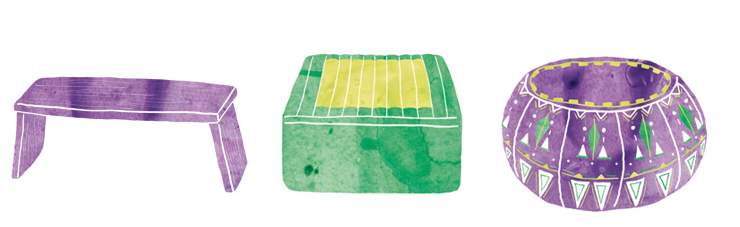
meditation cushions

Meditation benches allow you to sit in a relaxed kneeling position while keeping your posture aligned.

Rectangular cushions, or gomdens, are good for sitting cross-legged, and come in various heights and degrees of firmness.

Round cushions, or , are used for cross-legged sitting or, placed on their side, between the legs, for a kneeling posture.


This article appeared in the June 2017 issue of Mindful magazine.


How to Practice Mindfulness

Meditate at Your Desk

The post How to Find the Right Meditation Posture for Your Body appeared first on Mindful.


from RSSMix.com Mix ID 8196908 https://www.mindful.org/find-right-meditation-posture-body/

Friday, 4 August 2017

Two Lessons on Blame from Brené Brown

Here’s how to tell if you’re a blamer: When something goes wrong do you immediately want to know whose fault it is or do you make room for empathy and accountability? If you’re guilty of the former, you’re probably a bit of a blamer—But take heart, you’re in good company. In this animation by the Royal Society for the encouragement of Arts, Brené Brown shares a funny story illustrating the magnitude to which she’s a blamer (spoiler: it ends with her getting hung up on by her husband). Brown goes on to share some research and insights into this toxic behavior—Here are two interesting takeaways:

Blame releases anger: We often try to fault others for our mistakes because it makes us feel like we’re still in control. “I’d rather it be my fault than no one’s fault, says Brown.” But leaning into the discomfort of mistakes is how we can learn from them. “Here’s what we know from the research,” says Brown, “blame is simply the discharging of discomfort and pain. It has an inverse relationship with accountability. Blaming is a way that we discharge anger.”

Blame is simply the discharging of discomfort and pain.

Blame is faster than accountability: Accountability is a vulnerable process that takes courage and time. “It means me calling you and saying, hey my feelings were really hurt about this, and talking,” says Brown. People who blame a lot seldom have the tenacity and grit needed to hold people accountable. “Blamers spend all of our energy raging for 15 seconds and figuring out whose fault something is,” adds Brown. It’s difficult to maintain relationships when you’re a blamer, because when something goes wrong, we’re too busy making connections as quickly as we can about whose fault it is, instead of slowing down, listening, and leaving enough space for empathy to arise.


Feeling Overwhelmed? Remember “RAIN”


Cooling the Raging Fires of Anger

The post Two Lessons on Blame from Brené Brown appeared first on Mindful.


from RSSMix.com Mix ID 8196908 https://www.mindful.org/two-lessons-on-blame-from-brene-brown/

Three Blessings in Spiritual Life – Part 2: Inner Fire - Tara Brach

Three Blessings in Spiritual Life – Part 2: Inner Fire

This 3- part series explores three capacities we all have, that when cultivated, bring spiritual awakening and serve the healing of our world. Drawing on an ancient teaching story from India, we explore together the power of a forgiving heart, the inner fire that expresses as courage and dedication, and the inquiry of “who am I” that reveals our deepest nature.

photo: Shell Fischer – Mindfulvalley.com

The post Three Blessings in Spiritual Life – Part 2: Inner Fire appeared first on Tara Brach.


from RSSMix.com Mix ID 8196908 https://www.tarabrach.com/three-blessings-inner-fire/

Thursday, 3 August 2017

Meditation: Open Awareness – Relaxing Back into Presence (19:22 min) - Tara Brach

Meditation: Open Awareness – Relaxing Back into Presence –

This practice brings attention to the continuous space within and around the body, and the aliveness of sound, sensation and feeling that lives through us. While it’s natural for attention to get distracted, the pathway home is a relaxing back into the awake space that is aware of this changing life.

photo: Shell Fischer mindfulvalley.com

The post Meditation: Open Awareness – Relaxing Back into Presence (19:22 min) appeared first on Tara Brach.


from RSSMix.com Mix ID 8196908 https://www.tarabrach.com/meditation-open-awareness-19/

How Meditation Protects the Aging Brain from Decline

Most of us begin to misplace our keys, forget people’s names, or solve math problems less readily as we approach middle age. This is often referred to as age-related cognitive decline. Years ago, scientists believed that this decline was inevitable, but extraordinary research in the past two decades has shown that the adult brain changes with experience and training throughout the lifespan – a phenomenon known as neuroplasticity.

Neuroplasticity isn’t a given. Epidemiological research finds that how a brain ages depends on a number of factors including diet, physical exercise, lifestyle choices, and education. The healthier and more active one’s lifestyle, the more likely he or she will maintain cognitive performance over time. And meditation may be a key ingredient for ensuring brain health and maintaining good mental performance. Here’s what recent research suggests about how mindfulness meditation practice may help keep aging brains fit and functional.

How Meditation Leads to Neuroplasticity

To maintain mental acuity, it’s important to keep what researchers call your neural reserve in good working order. This “reserve” refers to your brain’s mental efficiency, capacity, or flexibility. Emerging evidence suggests that the consistent mental training that occurs in mindfulness meditation may help to keep that “reserve” intact. For example, one review of the evidence linked regular meditation with positive improvements in brain function such as heightened attention, awareness, working memory, and greater mental efficiency.

Studies are showing that daily meditation impacts both brain “states” and brain “networks”. Brain state training involves activating large-scale networks within the brain that affect a broad range of emotional and mental processes. A clever example of this can be found in a recent study published by a group of researchers at UCLA, who reported that experienced meditators have higher concentrations of tissue in brain regions most depleted by aging, suggesting that meditation practice may help to minimize brain age, and protect against age-related decline.

Brain network training, on the other hand, is more focal in that it improves specific cognitive abilities by repeatedly activating a network associated with one function, like paying attention. This is equivalent to repetitive mental bicep curls. Both state and network training are believed to be important ingredients for keeping the brain sharp.

The Agile Aging Brain

Meditation may provide another added benefit – increased mental flexibility. For some, age can come with a rigidity of thoughts, feelings and opinions, and the inability to flow with the challenges and obstacles that are part of the tide of life. That can be a source of stress, and potentially even illness. Because most meditation practices emphasize developing an awareness of thoughts, feelings, and physical sensations without creating a narrative or judgment about the experience, mindfulness mediation may help to lessen a person’s attachment to fixed outcomes, increase mental flexibility, and add to one’s neural reserve.

Although encouraging, it’s important to note that this research is in its infancy and results are mixed. For example, a number of studies have reported that older meditators outperform age-matched non-meditators, or function comparably to younger participants on a number of attention tasks. Others have shown little or no change in cognitive function following a mindfulness intervention for older adults, or report that improvements are not maintained over time.

What we do know is that long-term engagement in mindfulness meditation may enhance cognitive performance in older adults, and that with persist practice, these benefits may be sustained. That’s great news for the millions of aging adults working to combat the negative effects of aging on the brain.


Meditators Have Younger Brains

A Basic Meditation to Train Awareness

The post How Meditation Protects the Aging Brain from Decline appeared first on Mindful.


from RSSMix.com Mix ID 8196908 https://www.mindful.org/meditation-protects-aging-brain/

Wednesday, 2 August 2017

How Mindfulness Gives You an Edge at Work

Work is expending effort, usually to accomplish something, to meet an objective. Whether you work for love or for money or, if you are fortunate, for both at the same time, you want your efforts to be worthwhile.

This is why mindfulness—the objective observation of whatever is occurring—is a core capability at the foundation of a successful, fulfilling career, and of optimal performance in anything that we do. When you apply mindfulness to work, you give those efforts meaning and become more engaged, more attuned.

Working consciously is deciding and acting upon what you want to accomplish and how you will accomplish it. It recognizes the complex nature of work, particularly when it is being done in teams and organizations with other people. This involves the interplay of mindfulness, multiple intelligences, personalities and relationships, tools and methods, hierarchies, motivations, and ethics. In other words, this is systems awareness, which can easily get out of hand without a sense of mindful attention to how the individual components connect with the whole.

Mindfulness in Action

Mindfulness has hit the mainstream and been subject to scientific studies to verify its effectiveness. Major organizations like Google and the US Army are promoting mindfulness training for their employees, from the executive suite to the shop floor, trading desk, and customer service department. School systems and training organizations are beginning to incorporate mindfulness into their curricula both for students and trainers. Project managers, psychotherapists, and attorneys are recognizing the power of mindfulness. See A Guide to Mindfulness at Work for more on this.

Why is mindfulness getting this attention? Because preliminary research suggests mindfulness contributes to personal health, happiness, resiliency, and effectiveness.

For example, in 2010, an analysis of 39 studies explored the use of mindfulness-based stress reduction and mindfulness-based cognitive therapy. The findings suggested that “mindfulness meditation promotes joy, interest and alertness and other positive moods and decreases anxiety, anger and other negative feelings.” The article goes on to point to studies to show the effects of mindfulness on reduced rumination, emotional reactivity and stress, enhanced working memory, more cognitive flexibility, open mindedness and the ability to creatively adapt to changing situations.

Scientific studies help build confidence around the benefits of mindfulness and whether this might be something worth bringing into the workplace. However, working with the mind is very subtle and subjective. You must see for yourself, experientially. Practice yourself and experiment to see how your life and performance are affected.

The Power of Mindfulness

Imagine a situation in which you are expected to produce something quickly and perfectly within a very short time. You have been in this situation many times before and have seen the results: late delivery of a disappointing outcome, and being blamed for it. This time you have had it. You are not going through the same agony.

Your response and its effectiveness is a direct result of the degree to which you are mindfully aware. Without mindfulness, there is reactivity: anger, withdrawal, depression. With mindfulness, you can manage expectations, conflict, projects, communications, and relationships to get the result you want. Mindfulness also helps you accept that you might not get what you want. It promotes a realistic, objective view of reality. This cuts through delusional thinking.

Mindfulness also helps you accept that you might not get what you want. It promotes a realistic, objective view of reality. This cuts through delusional thinking.

Two Ways to be More Mindful at Work

To find a sense of balance that offers these benefits yet also fits into your lifestyle, it helps to cultivate both formal practices, like meditating, and informal practices, like connecting with a sense of inner peace while waiting for your morning coffee.

1) Formal Meditation Practice

Mindfulness is cultivated through meditation. Meditation is a mental exercise that fosters concentration and mindfulness. A meditation session is a retreat. It can last for a moment, or 20 to 30 minutes, a month, or more. During your retreat, you pull back from the ongoing hum of day-to-day living to train your mind, refuel, reflect, and perhaps most importantly, get in touch with your most expanded awareness.

For those who are not familiar with the mindfulness or insight meditation practice, here is an instruction from my book, Managing Expectations, about the core technique:

  • Find a comfortable, relaxed, alert posture—head, neck, and spine naturally aligned.
  • Rest your hands and arms comfortably.
  • Sit with your body balanced and stable, lips slightly apart, a subtle smile.
  • Feel the sensations of your body.
  • Take note of your breath. Just notice the sensation of inhalation and exhalation wherever it is most prevalent for you—at the nostrils or in the rising and falling of the chest or abdomen.
  • Notice thoughts, feelings, sensations, sounds, sights, smells as they occur.
  • Greet everything that occurs with a friendly accepting attitude, bringing your attention back to the breath.
  • If you get “lost,” carried away, or distracted: as soon as you realize it, come back to the body, the breath, and begin again.

This is a technique for formal practice—sitting down for a fixed time and dedicating five, ten, 20, or more minutes to meditating. This is an exercise that relieves stress, strengthens your concentration and mindfulness, and makes it more likely that the results will seep into the rest of your day—including your work.

And it is the rest of your day that is most important. Here is where the rubber meets the road. Here’s where you spend most of your time.

2) Moment-to-Moment Techniques

Moment-to-moment meditation takes the practice into the normal day’s activity. You can practice for brief moments during work sessions, meetings, lunch, bathroom breaks, etc. Make it subtle and let it become integrated into your life so that it enhances your ability to completely attend to your work in the most effective way.

There are many moment-to-moment meditation practices. Here are two you can try. One is very concrete and the other, subtler:

  • Wait for the ring: Whenever the phone or your computer rings or pings take three conscious breaths before responding. A conscious breath is one that is felt and observed.
  • Notice your wandering mind: Whenever you realize that you have been off on a mental journey or in a waking dream state, take note of your experience in that moment of awakening, take a conscious breath, and carry on. For example, imagine being at a meeting or in a class, you are daydreaming or caught up in thinking about something, and are called upon to comment on what was just said. What does it feel like in that moment? Recognize the difference between being awake and asleep, experience the feelings that come up, and note your response.

The main point is that mindfulness is a foundation for effective work and optimal performance and that mindfulness can be enhanced and cultivated by practicing formal and informal meditation.

10 Ways to Be More Mindful at Work

How to Practice Mindfulness Throughout Your Work Day

The post How Mindfulness Gives You an Edge at Work appeared first on Mindful.


from RSSMix.com Mix ID 8196908 https://www.mindful.org/mindfulness-gives-edge-work/

Job Posting: Interim Director, Business Development and Partnerships

The Mindful media team is seeking a colleague to join in the area of partnership management and new business development. This is a six-month term with the possibility of extension.

The Foundation for a Mindful Society (Mindful), an independent non-profit located in Halifax, Nova Scotia, is dedicated to inspiring, guiding and connecting anyone who wants to explore mindfulness—to enjoy better health, more caring relationships, and a more compassionate society. We use our media and community building expertise as the publishers of Mindful magazine and mindful.org to accomplish this. We also undertake initiatives that help support the mindfulness field more broadly, and are increasingly branching out into projects that look at mindfulness in connection with various sectors and civic institutions.

Our goal is to help support the work that’s being done and create new opportunities by telling stories, connecting people, providing vital information, and catalyzing key events and initiatives. In this way, we aspire to develop a community that will make mindfulness and mindfulness-based practices a routine part of North American society.

Working under the direction of the Executive Director and closely with the General Manager and other Mindful staff, as well as independently, the Interim Director, Business Development and Partnerships will broadly be responsible for:

  1. Overseeing the care and development of relations with key partner organizations
  2. Managing to successful completion all projects inherited from the current Director of Partnership
  3. Creating, developing and managing new projects that fulfill Mindful’s mission and develop new income streams, including conferences, content deals, and special projects
  4. Negotiating and managing sponsorships and affiliate programs

In doing so, the Interim Director, Business Development and Partnerships will work closely with the circulation, advertising, editorial and art departments to develop and implement emerging initiatives.

Specific qualifications, skills, and experience:

  • established record of success in initiating and managing projects and campaigns
  • proven ability to build and maintain positive relationships
  • understanding and spirit of entrepreneurship
  • well-honed organizational skills
  • excellent written and verbal communications skills
  • creative and strategic thinking skills
  • marketing and/or publishing experience an asset
  • interest and/or experience in mindfulness an asset

Salary is commensurate with experience. Candidates must be eligible to work in Canada.

Deadline for Applications: August 18, 2017

Apply by email with “Interim Director, Business Development and Partnerships” in the subject line and attaching covering letter and resume to Cindy Littlefair at cindy@mindful.org

The post Job Posting: Interim Director, Business Development and Partnerships appeared first on Mindful.


from RSSMix.com Mix ID 8196908 https://www.mindful.org/job-posting-interim-director-business-development-partnerships/